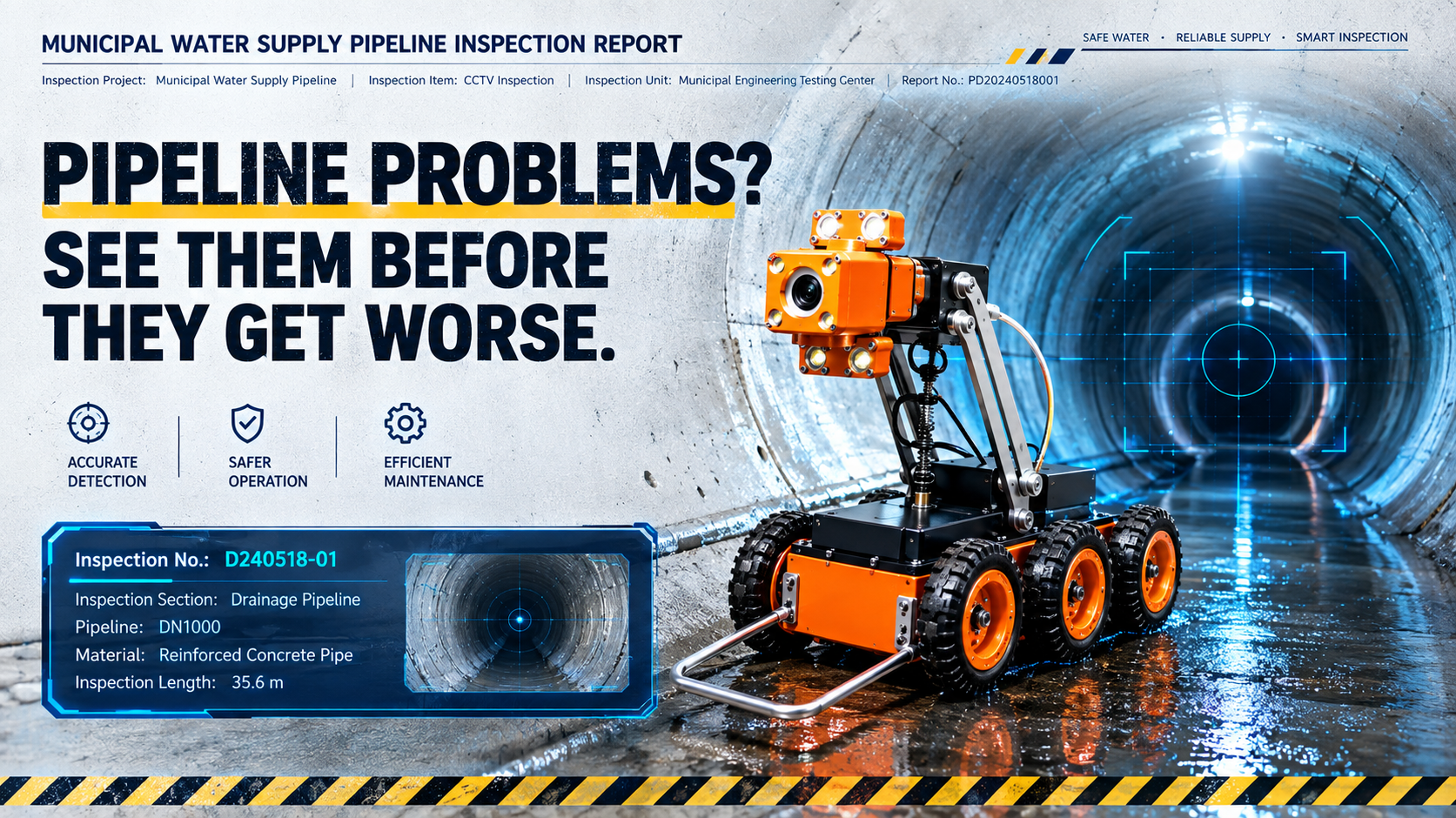
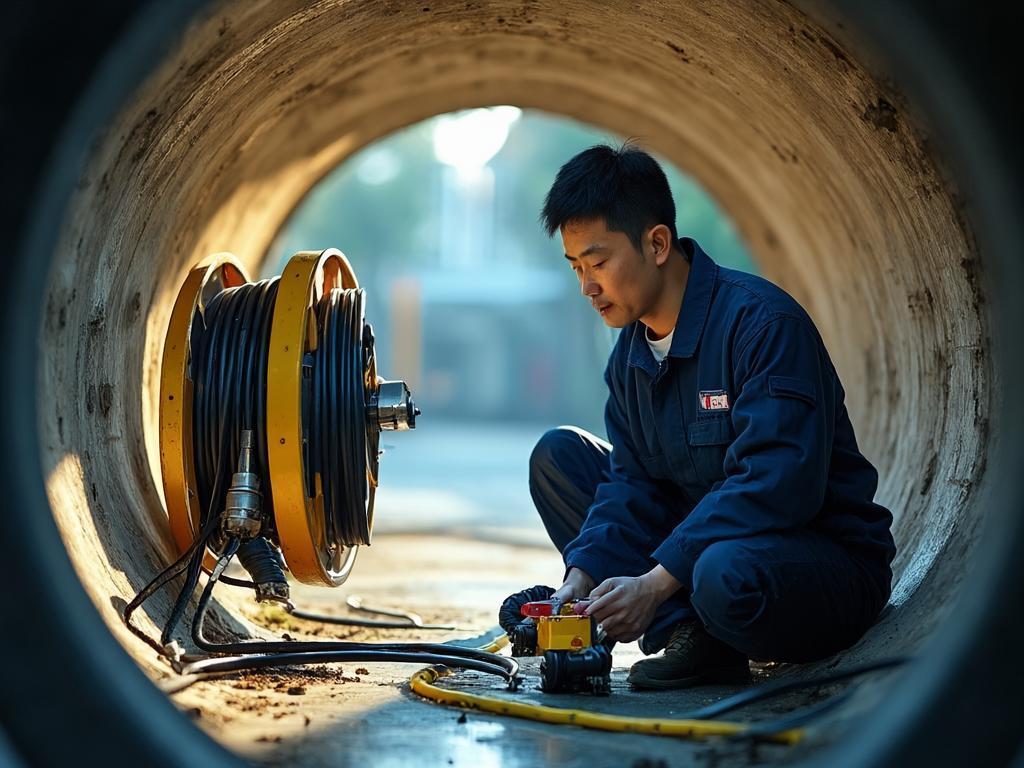
At municipal drainage inspection sites, many inspection teams ask when choosing equipment: two crawler robots look similar on paper, so why do they perform completely differently after going down the manhole? The conclusion in one sentence: power parameters are not about a single high number — they are about matching the actual conditions of your pipe sections.
Look at the Drive Design First, Then the Climbing Angle
Comparing power starts with the drive structure. Common conditions in municipal drainage networks are: pipe diameters ranging from 300mm to 1500mm, sediment deposits inside the pipe, and height differences between the manhole and the pipe section.
With a multi-wheel independent drive crawler robot, when one drive wheel slips, the other wheels continue to deliver power, so it handles silted sections more easily.
The climbing angle parameter should be understood in context: inspection robots crawl along pipe bottoms with water and mud. Cement and plastic pipe walls have different friction coefficients, so the same slope can perform differently in reality.
Therefore, when comparing climbing angles, do not just look at the rated value — look at performance under the same pipe material and silting conditions.
Obstacle Crossing Depends on Structure, Mud Passing on the Chassis
Obstacles inside pipes are not only steps, but also sediment, bricks and root intrusion. The obstacle-crossing height parameter reflects whether the robot can cross these local obstacles.
On site, you can place the robot in a test section with obstacles and observe whether its body stays stable when crossing and whether the camera image shakes too much.
Mud-passing capability mainly depends on chassis design and wheel type. An all-terrain chassis with large-diameter tires has a larger contact area in sediment and is less likely to get stuck.
One thing to note: while more power helps, it also increases the weight and size of the robot. If the inspected pipe diameter is small, the robot may enter but cannot turn — extra power becomes useless.
Matching Field Conditions Matters More Than Stacking Parameters
When comparing power parameters, we suggest following three lines:
First, the applicable pipe diameter range — the minimum turning radius and body width should be smaller than the minimum pipe diameter to be inspected.
Second, climbing and obstacle-crossing capability should have some margin, because actual pipe bottoms are more complex than standard test environments.
Third, waterproofing and sealing — in water-bearing inspection scenarios, reliable long-term operation of the drive system in immersion matters more.
For on-site comparison, you can run different robots through the same silted section and see which passes steadily and which needs manual intervention midway. This is more informative than comparing spec sheets alone.
A Solution Matched to Your Field Conditions Deserves a Survey First
FAQ 1: Is a larger climbing angle always better?
No. The climbing angle is only one expression of power output. What matters is whether it matches the slope distribution of your network. A very large climbing angle often comes with a larger body, which may sacrifice passability in small-diameter pipes.
FAQ 2: How do I judge whether a heavily silted section can be inspected?
It depends on the ratio of sediment depth to pipe diameter, and the ground clearance of the robot chassis. As a general rule, when sediment does not exceed a certain proportion of the pipe diameter, an all-terrain chassis can pass; the specifics should be confirmed by an on-site survey.
There is no standard answer for municipal drainage inspection conditions — power parameter comparison ultimately comes back to your actual pipe sections. DannaBot can bring the D8 pipe inspection robot to your site for a live demonstration and discuss selection ideas based on your pipe diameter, sediment and slope. Contact DannaBot to arrange an on-site survey and let the equipment speak in real pipes.